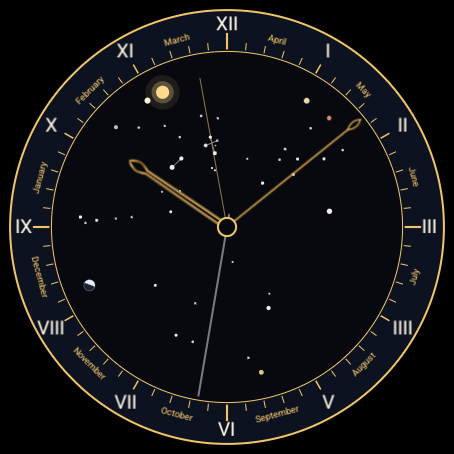
The lost stars
The four bright stars of the Cross were once seen from the Mediterranean. Over thousands of years the slow wobble of Earth's axis carried them below Europe's horizon, and the old astronomers counted them as part of the Centaur.
Dante, imagining himself in the southern hemisphere, wrote of four stars, never seen except by the first people
. Later navigators would say he had seen the Cross.
No star at the pole
Sailing south along Africa, the Portuguese and Italians watched the North Star sink lower each night until it was gone. The south has no pole star. They needed a new guide.
Finding its name
A southern chariot
, wrote Alvise Cadamosto off the Gambia in 1455. The Guards
, wrote Mestre João Faras from Brazil in 1500. An almond, said the letters of Vespucci.
Then in 1516 Andrea Corsali, sailing for India, wrote to Giuliano de' Medici of a marvellous Cross
, so beautiful that no other sign in the heavens could compare.
A clock in the sky
Corsali saw something more. The Cross and its neighbours go around the pole, he wrote, and make their course in twenty-four hours: fa suo corso in xxiiii hore.
It is the earliest clear record of the Cross as a hand turning once a day around a dial of sky.
The hour and the season
José de Acosta found the Cross hermoso y de vista admirable, beautiful and admirable to behold. He also told how pilots used it. They waited for the star at the foot of the Cross to stand upright before they measured it, and that moment came at one time of night, at a different hour in each season.
That is the Hand of the Cross. The clock hands keep the hour. The Cross keeps the season.
Compass, measure and clock hand
One figure in the sky gave a sailor four things: the way to the pole, his latitude from the height of the foot star, the hour of the night and the time of year.
The awe never faded
Three centuries later Alexander von Humboldt wrote that the southern sky left an ineffaceable impression
on him, and he called the universe a great chronometer
.
A better clock than ever
The wobble that once hid the Cross from Europe has never stopped. Right now it is carrying the Cross toward the pole almost as fast as it can move any star: a Moon's width every century.
- 2.8°closer to the pole than when Corsali saw it
- 35.6°S → 32.7°Swhere the whole Cross circles all night, then and now
- Sydneynow sees the whole Cross circle all night on a clear, flat horizon. In 1516 it could not.
And for the first time the hand can be set exactly. At midnight on 1 April 2026, on the meridian through Cumnock in New South Wales and St George in Queensland, the Cross stood upright as the clock hands met at XII. Corsali could describe the turn. Now it is calibrated to the minute.