The Crux Movement — Southern
The Southern Cross turns clockwise around the South Celestial Pole. Set beside familiar civil hands, month and sidereal indicators, its changing position becomes a readable expression of the southern sky.
Beyond the Clock
For most of human history, the heavens served as humanity's clock, calendar and compass.
Today, we carry time in our pockets. We know the hour without observing the Sun, and the date without looking at the stars.
Yet above us, the great celestial clock continues its uninterrupted motion.
SiderealClocks does not seek to replace the clocks we already own. It seeks to restore something we have almost forgotten: the ability to look towards the heavens and understand the passage of time.
The sky is the clock. The stars are its hands.
These are not pictures of clocks. They are live astronomical instruments, bringing civil time and the changing sky into one readable field.
Two hemispheres. One turning Earth.
The Southern Cross turns clockwise around the South Celestial Pole. Set beside familiar civil hands, month and sidereal indicators, its changing position becomes a readable expression of the southern sky.
Polaris marks the northern pole as the star field turns anticlockwise around it. Conventional civil hands continue clockwise, allowing two different forms of time and motion to remain visible at once.
Both instruments reveal different views of one rotating Earth. Their circular geometry, astronomical motion and geographic relationship to time are central to the invention.
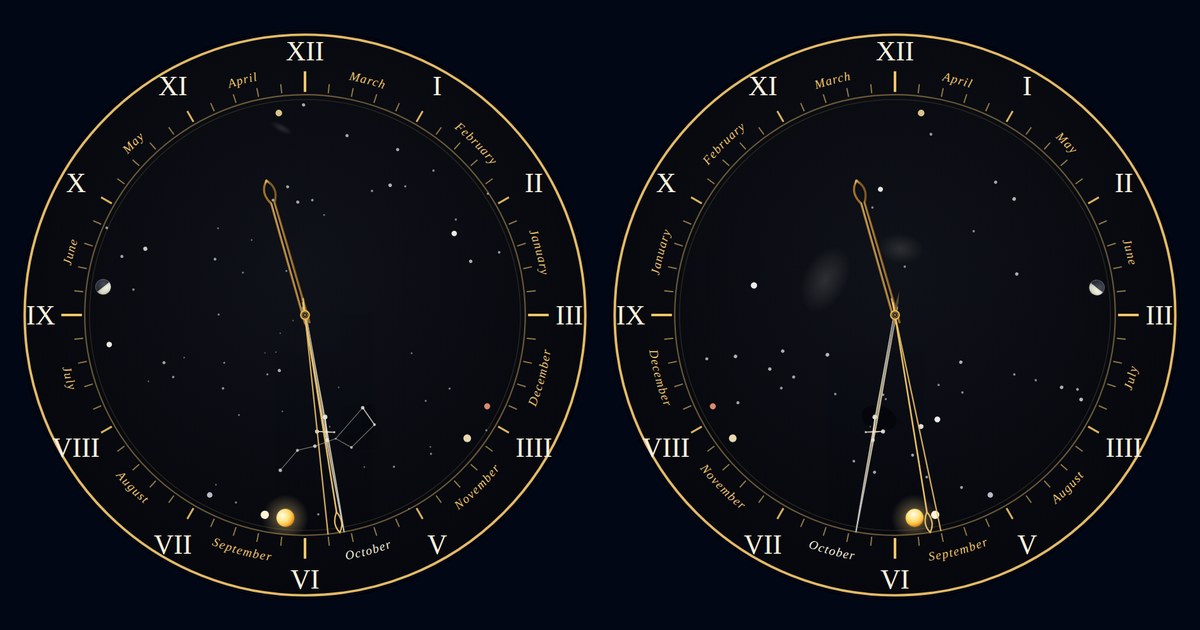
The live dials · Northern and Southern
A piece of the universe, made for a place on Earth
We do not envisage generic screens. We envisage bespoke architectural timepieces, mathematically calibrated to the geographic longitude and chosen reference meridian of the place they occupy.
Every memorable public building has a centre of gravity—something that makes visitors pause, look up and feel part of a larger story. A SiderealClock could carry the enduring traditions of public timepieces and celestial navigation into contemporary architecture: a striking centrepiece that also reveals genuine celestial mechanics.
Possible physical forms remain proposals: circular LED displays, framed square displays, architectural enclosures and gallery pedestals.
A future capability
Within the outer lane of each instrument, the Sun, Moon and visible planets follow their changing celestial paths. At times they appear to approach one another, creating opportunities to explain close approaches, conjunctions, elongations and, on rarer occasions, genuine eclipses or occultations.
Our aim is to give these moments names, context and meaning—turning a passing relationship on the dial into a moment of astronomical discovery.
The bodies are compressed into a narrow graphical lane and the Sun and Moon use enlarged illustrated discs. Screen overlap cannot prove a conjunction, occultation, transit or eclipse. A future shared module must calculate and classify events independently using Astronomy Engine, defined conventions and appropriate observer geometry.
The clocks will remain visually intact. Event information may be disabled, will work offline, and will appear quietly beside the instrument rather than over it. Production detection is a separate, tested development stage.
The living history of celestial time
Not clock time alone. Not calendar time alone. Celestial time: time written in the sky, read by people for millennia and made visible again through a living instrument.
The clock is the vehicle; history gives it context. This is not nostalgia, but the recovery of a way of seeing—the turning Earth, the moving heavens and the measurable relationship between them.
Future exhibitions can connect that experience with navigation, nocturnals, astrolabes and the recorded work of observers including Andrea Corsali, Alexander von Humboldt and Alan S. Hawkesworth. Across cultures, including Christian and Indigenous traditions, the heavens also carry meanings beyond measurement; those histories require evidence, specific attribution and appropriate cultural collaboration.
Explore the classroom activity →
A State Library of New South Wales exhibition concept under development—not a confirmed commission, partnership or endorsement.
For display manufacturers and collaborators
We are seeking relationships with manufacturers of high-resolution circular and square displays, fine-pitch LED and COB systems, integrated controllers and architectural display assemblies.
A practical first step is testing the existing live software on suitable demonstration hardware: star-point clarity, small text, black levels, viewing distance, circular presentation and continuous reliability. From there, possibilities may include evaluation equipment, prototypes, technical advice, manufacturing quotations, licensing, referrals, distribution or project collaboration. Every arrangement would be negotiated individually.
Museums, libraries, observatories, universities, architects, exhibition designers, collectors and commissioning partners are equally welcome to begin a conversation.
William Turner Founder · Sidereal Clocks
A world connected by the turning sky
A future family of self-contained instruments could let visitors in Australia and Europe compare opposite celestial perspectives—and recognise their common cause: one rotating Earth. Network connection may enrich the experience, but it will never be required for the clocks to operate.